Rhinecliff
American WomanRhinecliff is the Hudson River station where Jenny’s flight from New York turns into an improvised search for somewhere to live and work. She chooses it at random, measuring the distance by how far one fourth of her money will take her. The town itself is not presented as a permanent refuge: its deserted platform, costly nearby lodging, and connection to the country roads make it a point of arrival and passage. But it becomes decisive in her story because Frazer finds her there, and because the life she assembles after leaving the station remains shadowed by the identity and relationships she cannot safely disclose.
Arrival by the River
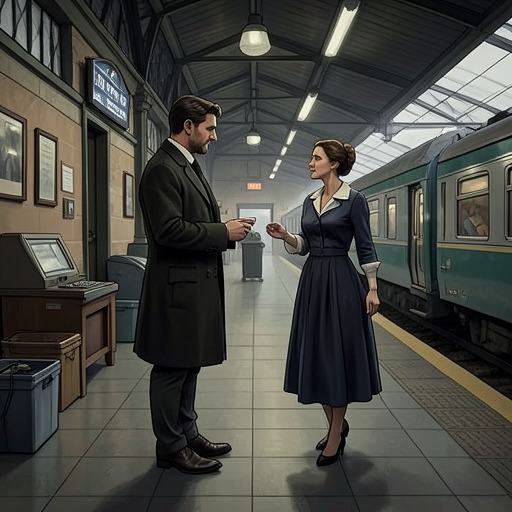
After the train journey from New York, Jenny stands for a long time on Rhinecliff’s deserted station platform with a duffel bag and an accordion file. The river has accompanied the train for the whole trip. At the station she notices the smell of rotting vegetation and, unexpectedly, brine; although the ocean is now two hours farther away, the scent seems stronger at low tide. The river is thus both the most immediate feature of her new surroundings and a reminder of the distance she has travelled without bringing her closer to the coast.
Eventually Jenny walks to the front of the station, calls a taxi, and asks for the nearest motel. There is only one, miles inland near Rhinebeck. Its cost takes another large portion of her funds, making the choice of Rhinecliff practical but precarious: getting away from New York has not yet secured her a livelihood or a place to stay. The station platform, the taxi, and the inland motel form a short sequence of decisions made with limited money and few options, rather than the arrival in a settled home.
A Route into Rural Hiding
The day after Jenny reaches the motel, she sees an advertisement for work at Wildmoor in the Rhinebeck Gazette. She later learns that the advertisement had been running for months without responses because Dolly rarely made payments, a circumstance widely known in town. Jenny does not know this when she accepts the position. As an immigrant without options, she agrees to take board as part of her pay. By late October 1972, she has moved from the station and motel into a precarious rural arrangement, with the Nixon placards at the ends of the concealed drives through yellow-leaved woods marking the country setting around her new life.
Her attempt to build a discreet routine extends beyond the immediate area. Jenny chooses Red Hook for a post office box because it is barely a town and its post office sits alone beyond a desolate intersection. She calls herself Iris Wong and subscribes to the Rhinebeck Gazette. Two or three evenings a week, after the post office window has closed, she drives to Red Hook, collects the small accumulation of papers, and reads them in her car in a neglected riverside park. She begins with the national-news capsules, opening each paper to the relevant page and scanning with her head slightly turned. The journey from Rhinecliff has therefore led not to one secure address but to a dispersed existence: work near Rhinebeck, a mail identity in Red Hook, and repeated trips to gather news without drawing attention.
Where Frazer Finds Her
Rhinecliff later becomes the place where Frazer finds Jenny. Their renewed contact does not erase the distance between them: when they travel together from the Rhinecliff area, Jenny leads him across the river and along nearly five miles of level rural roads, changing roads repeatedly. Frazer begins to suspect that she is trying to lose him again, though she keeps precisely to the speed limit. The route climbs into wooded country, past rockface and a deep ravine, with Jenny slowing almost to a crawl at each bend and sounding her horn before proceeding. In this episode, the landscape beyond Rhinecliff is not simply a scenic extension of the station; its turns and blind curves make following someone an uncertain act.
The journey ends at a small, dark house near the top of a grassy slope, reached by a faint dirt track. The house stands before dark woods, with enough elevation to give warning of anyone approaching from the road. Carol is outside waiting at dawn and directs the car around back. As the long ride alone ends, Frazer suddenly takes Jenny’s hand, then releases it before they stop. Rhinecliff is not the destination of this drive, but it is the point from which the pair move into a charged reunion and toward the house where the fugitives are gathered.
Private Life and Narrative Significance
When Frazer finds Jenny in Rhinecliff, she is in the middle of writing to William. The letter she is answering is nearly four weeks old, and his words about zealots and the damage they do to shared ideas have acquired a painful immediacy: Jenny is now living among the people he means, while concealing that fact from him. She repeatedly tries to finish her response, but the circumstances of her new life leave too much that cannot safely be included. In the end, she begins again with an account of searching for a yellow croquet ball, writing as though she were still at Wildmoor. The letters must convey honesty while withholding clues that prison censors could understand, so their coded intimacy also requires a kind of deception.
The correspondence had once offered Jenny and William a modest, shared understanding: she signed herself as his sister, and he answered as her brother. But from Rhinecliff, the limits of that arrangement grow more painful. The letters can only signal across separation, and Jenny feels their connection weakening even as she devotes energy to maintaining it. In this way, Rhinecliff marks more than a geographic change from New York to rural New York State. It is the fragile interval in which Jenny has escaped one life but has not found a way to reconcile her new concealments with the old attachment. The station’s role is brief in practical terms, yet its arrival and reunion scenes make it a hinge between flight, concealment, and the return of a relationship that distance has not resolved.